Lifters, hybrid & Hyrox athletes · Farmers Branch & North Dallas
Your back tweaks every time deadlifts get heavy. Your shoulder hates pressing. Your knees ache after a week of running on top of squats, and you've started programming around the pain.
Training isn't the problem. Somewhere, the load is outpacing what your body can handle, or one area is doing more than its share. We find it, keep you training while we fix it, and get you back to your numbers.
★★★★★ 5.0 from 90+ Google reviews
What we treat
Barbell, kettlebell, Hyrox, CrossFit-style or hybrid. The lifts change. The problems usually don't.
1
Back that tightens or goes out on deadlifts, squats, cleans or after a heavy week.
2
Pain on bench, overhead press, push-ups, dips or pull-ups, or in the front rack.
3
Knees that ache in the bottom of a squat, on lunges and wall balls, or when running stacks on top of lifting.
4
A pinch at the bottom of a squat or in a deep hinge that limits depth and position.
5
Pain gripping, pulling, in the front rack or on burpees and push-ups.
6
Sled pushes, burpee broad jumps and run volume piling up until something gives.
The real reason
Lifting doesn't hurt people. Load that outpaces capacity does, especially when one area ends up doing more than its share.
1
A new program, a meet or race block, more running on top of lifting. Tissue adapts slower than motivation.
2
When the hips, upper back or feet don't do their job, the low back, shoulder or knee picks up the slack, rep after rep.
3
If you can't get into a position under control, the bar finds the weakest link. Mobility and control in range fix it, not more stretching.
Your evaluation
1
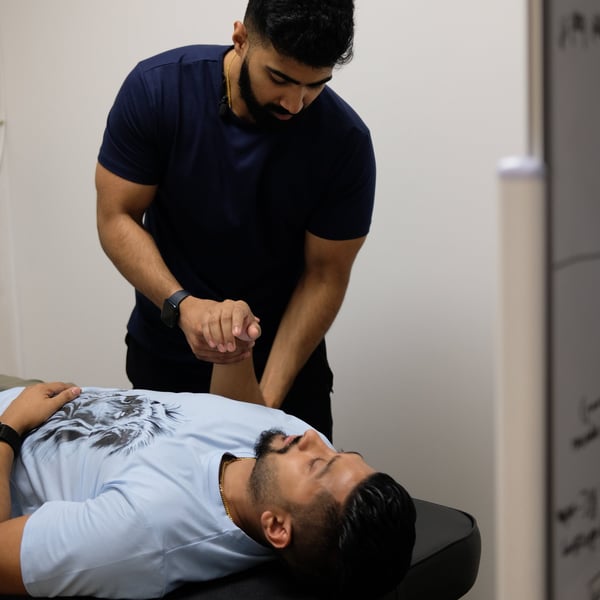
Your program, your week, your lifts and numbers, what you're training for, and when it started hurting.
2
Squat, hinge, press, pull and carry patterns, so we see where the load actually goes and where you're compensating.
3
What to change now, what to keep, and how we'll build you back to working weights and race day.
Our take
“Stop lifting.” “Don't squat below parallel.” A light band and a sheet of exercises. Most rehab treats lifting as the problem and leaves you weaker than when you started.
Load is how we fix it. We modify what hurts instead of taking the bar away, rebuild the positions and capacity that broke down, and test you back up to the weights you were lifting before. The goal is your PRs, not just walking out pain free.
How we work
1
We adjust weight, range, volume or exercise choice so you keep your fitness while we fix the problem.
2
Targeted strength and control work for the area that's been overloaded, and for the areas that should have been helping.
3
We progress you back to your working weights and race pace, so you know you're ready, not just hoping.
Reviews
5.0 ★★★★★ from 90+ Google reviews
“I have been struggling with knee pain for years after multiple surgeries… after working with him for just a few months, I'm now training for my first hyrox pain-free! I'm no longer having episodes of swelling or needing weeks to recover, and I don't have to modify any movements in my workout classes.”
Jesse S.
Hyrox, knee pain
“Had lingering shoulder pain and he assured me he would get me feeling better. Given that I've had rotator cuff surgery before, I was a bit more than nervous… I'm back lifting as if it never happened.”
Jeffrey G.
Lifter, shoulder pain
“I have a bad knee and back pain from lifting and he has helped to give me the confidence again to workout freely without worrying about getting hurt.”
Michael C.
Lifter, knee and back pain
“Turns out nothing was wrong with my back, I was just not using my leg muscles properly, which caused my back muscles to work overtime during lifts at the gym or while serving at volleyball games.”
Lidia R.
Lifter and volleyball player
Who this is for
Barbell and powerlifting, Olympic lifting, Hyrox, CrossFit-style training, hybrid athletes running and lifting, and anyone tired of programming around the same injury.
FAQ
Usually not. Most people keep training while we fix the problem. We adjust weight, range, volume or exercise choice around what hurts, so you keep your fitness instead of losing it.
Yes, that's the goal. We rebuild your positions and capacity, then progress you back up to your working weights with a clear plan, not guesswork.
Yes. Running stacked on top of strength work is one of the most common reasons people come in. We look at your whole training week, not just the lift that hurts.
No. Deep squats are safe for healthy knees and build capacity. If deep squats hurt right now, we find out why and build you back into that range.
Happy to work alongside your coach. I'll tell you what to modify and why, and you keep the rest of your program.
Most people feel a difference in the first few weeks. A full plan is usually 6 to 12 weeks, depending on how long it's been going on and what you're training for.
If you felt a pop with sudden weakness or bruising (like a biceps or pec injury), have numbness or weakness down a leg that's getting worse, or have any change in bladder or bowel control after a lift, see a physician first. Otherwise, you can start with physical therapy without a referral.
Free 15-minute discovery call
You've tried the rest, the stretching, the foam roller, maybe a few other providers. You don't need more of the same. Pick a time and let's figure out what's actually going on.
✓ We talk through what's going on and what you've tried
✓ I tell you straight whether I can help
✓ No cost, no pressure, no commitment
Rather talk now?
Call or text (469) 972-6565
Email nevinsaju@revenantpt.com
Can't find a time?
Tell me what's going on and I'll get back to you within 1 to 2 business days.
.png?width=170&name=Revenant+long+logo+(white).png)
One-on-one performance physical therapy for active people in Farmers Branch and North Dallas.
Visit & contact
11488 Luna Rd
Farmers Branch, TX 75234
Inside Luna Fitness Studio
(469) 972-6565
nevinsaju@revenantpt.com
Mon & Fri: 9 AM to 5 PM
Tue to Thu: 9 AM to 7 PM
By appointment only
© 2026 Revenant Physical Therapy. All rights reserved.
PRIVACY NOTICE: No mobile information will be shared with third parties/affiliates for marketing/promotional purposes. All other categories exclude text messaging originator opt-in data and consent; this information will not be shared with any third parties. We do not share personal data (phone numbers) and consent with third parties / affiliates. If you wish to opt-out of SMS messages with us please send us via SMS or EMAIL: "REPLY STOP TO CANCEL MESSAGES FROM REVENANT PHYSICAL THERAPY"
.png?width=322&height=138&name=Revenant+long+logo+(white).png)