
Lifting & Hyrox8 min read · Dr. Nevin Saju, PT, DPT
The short answer
Most Hyrox injuries aren't one bad rep. They come from running volume the body wasn't ready for, high rep work under fatigue, and the way breathing, posture and control fall apart late in the race. The knee, low back and shoulder end up absorbing what the hips, trunk and rib cage stop handling. The fix is usually a smarter plan, not time off.
The person I see most often for Hyrox pain isn't a beginner to fitness. They're strong and fit, often coming from lifting, CrossFit or a completely different sport, and they've never run much. They sign up, start stacking runs on top of their usual training, and a few weeks later the outside of the knee starts aching. Or the IT band. Or the shoulder during wall balls.
It usually starts as something nagging, not dramatic. They push through it because the race is on the calendar, and it slowly becomes the thing they think about every session.
Hyrox is a lot. Eight 1 kilometer runs, each followed by a station: SkiErg, sled push, sled pull, burpee broad jumps, rowing, farmers carry, sandbag lunges and wall balls. It isn't for everyone, and it's hard to come out of a full training block completely unscathed. Some aches are part of the journey. The goal is keeping them from turning into the thing that stops you.
Where Hyrox injuries actually come from
There isn't good research yet on Hyrox injury rates specifically. But the pieces of the race are well studied, and the patterns line up with what I see.
- The running. The knee is the most common place runners get hurt. In triathletes, up to 73% of training injuries are linked to the running, not the swimming or cycling.
- Being new to it. In one triathlon study, 86% of athletes who got hurt had been in the sport for two years or less. Multiple disciplines stack up faster than people expect.
- Running tired. Running after another hard effort reduces how well your hips extend and tips your pelvis forward. That shifts load toward the knee, low back and hamstrings.
- Too much, too soon. Overuse injuries usually follow a jump in volume or intensity that outpaces what the tissue can handle yet.
In my clinic, the running and the wall balls cause the most trouble. Running brings the knees and IT bands in. Wall balls bring the shoulders. If knee pain is part of your story, runner’s knee and whether you can keep running goes deeper.
Fatigue doesn't create the weak link. It exposes it.
Why the knee, back and shoulder take the hit late in the race
Late in a Hyrox, breathing takes over. Your body prioritizes getting air in, and the muscles that normally hold your trunk and pelvis in a good position get pulled into that job. When that happens, the joints at the ends of the chain start absorbing what the middle stopped handling.
- The knee. As the glutes and calves fatigue, the hips stop absorbing force on the way down in lunges, wall balls and running. The knee does the braking instead.
- The low back. When the ribs flare and the pelvis tips forward, the hips can't finish extending on sled pushes, rows and wall ball drives. The low back arches to make up the difference.
- The shoulder. The shoulder blade glides on your rib cage. When the upper back stiffens and the ribs stay flared from heavy breathing, the shoulder blade can't rotate up to get your arm overhead. The shoulder joint and low back fake the range instead.
Lifting and training hard but something keeps flaring?
How I look at it
Where I'd start
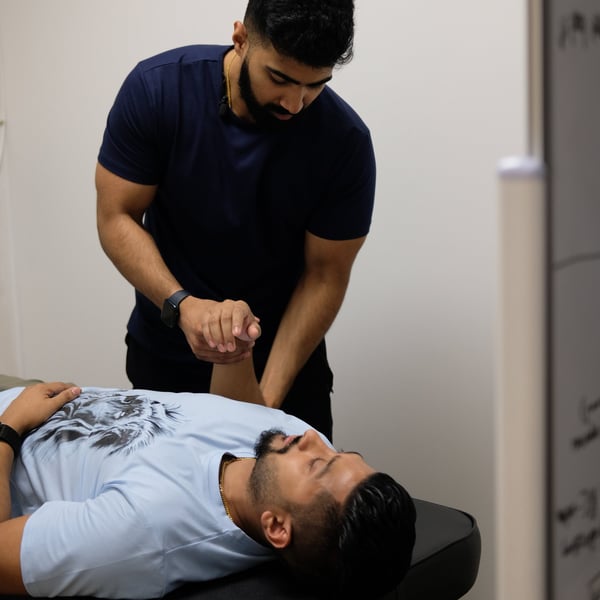
When someone comes in with Hyrox pain, I want to know whether the joint that hurts is the problem, or whether it's covering for something above or below it. Two checks help.
First, lie on your back with your knees bent. Breathe out fully until your ribs drop and your low back rests on the floor. Keep that contact and slowly reach both arms overhead. If your back arches or your ribs pop up before your arms get close to the floor, you don't have the overhead range wall balls ask for. You've been borrowing it from your low back.
Second, stand on the bottom stair and slowly lower the other foot toward the floor, keeping your weight over the middle of the standing foot. If your heel pops up, your knee caves in, or your chest pitches forward, your hip isn't absorbing the load. Your knee is.
That's my starting point, not the whole picture.
What to do about it
Keep your fitness, change the inputs, and build a plan that scales with your training instead of fighting it.
1
Don't stop unless you have to.
Unless it's a serious injury that truly needs time away, you shouldn't lose your fitness. Change what you're doing so the irritated area can calm down while everything else keeps working.
2
Cut the redlining, not the training.
Most people train for Hyrox by going all out over and over. Swap a chunk of those sessions for steady aerobic work on the bike, rower or SkiErg where your breathing stays calm and your ribs stay down. A bigger aerobic base means you hit the late race panic later.
3
Use the sled as a tool.
Backward sled drags are one of my go-to tools here. They work the quads and calves hard without the pounding of running or jumping, which helps knees that don't love running or lunges right now.
4
Build running volume like it's a new sport.
If you came from lifting or another sport, running is the new stress. Add it gradually, and don't increase running and station volume in the same week.
5
Back off, then build back up.
When something flares, I do the same thing in my own training. Back off, slowly reintroduce the movements, and load back up as your body shows it can handle it.
If it flares 4 to 6 weeks before your race
That's a tough spot. It depends on how severe it is. The first job is putting the immediate fire out. Then we look honestly at where your fitness is and adjust the plan, which sometimes means changing the race goal, not just the training. Showing up healthy and finishing beats limping through a race you trained months for.
If you're deciding whether to keep training through pain, read can you keep training while injured. For shoulders that hurt with pressing and overhead work, see why your shoulder hurts when you bench or press. You can also see how we work with runners or read what patients have said.
| What you've been told | What's usually going on |
|---|---|
| You just need to rest | Most Hyrox aches respond better to changing the training than stopping it |
| Your IT band is tight, roll it out | It's usually a load problem from running volume the body wasn't ready for |
| Wall balls are bad for your shoulders | The shoulder is often faking overhead range the rib cage and shoulder blade can't give |
| More conditioning will fix it | Redlining over and over reinforces the same breakdown patterns |
| Pain means you're doing it wrong | Some aches are normal. Pain that changes how you move or keeps building isn't |
| You'll have to skip the race | Not always. Calm it down, then adjust the plan to the fitness you have |
When to see a doctor first
See a physician before treating this yourself if you have:
- Chest pain, unusual shortness of breath, fainting or a racing heartbeat during or after training
- Severe muscle pain and swelling with dark or cola colored urine after a hard session
- A knee that locks, gives way or swells quickly after a twist or pop
- Numbness, tingling or weakness spreading down an arm or leg
- Pain that keeps getting worse at rest or at night
Common questions
What are the most common Hyrox injuries?
In my clinic, it's mostly knee pain and IT band pain from the running, and shoulder pain from wall balls. Low back pain from sleds, rowing and wall balls is close behind. Most of it is overuse, not one big moment.
Should I stop training for Hyrox if something hurts?
Usually not completely. Unless it's a serious injury that truly needs time away, the better move is to change what you're doing so you keep your fitness while the irritated area calms down and builds back up.
Is some pain normal when training for Hyrox?
Some aches are a normal part of training for an event this demanding. The ones to take seriously are pain that changes how you move, gets worse week to week, or keeps coming back in the same spot.
What if I get hurt 4 to 6 weeks before my race?
Calm it down first, then take an honest look at your fitness and adjust the plan. That might mean changing your race goal, not just your training. How much you can do depends on how severe it is.
Keep reading
Revenant Physical Therapy
Training for Hyrox and something won't settle?
Book a free 15 minute discovery call. Tell me what's been going on and what you've tried, and we'll figure out whether Revenant is the right fit to keep you training and get you to race day. Revenant Physical Therapy is based in Farmers Branch and works with active adults from Addison, Carrollton, and across North Dallas.

Written by
Dr. Nevin Saju, PT, DPT
Founder of Revenant Physical Therapy in Farmers Branch. Three open-heart surgeries taught him what it takes to trust your body again. Now he helps runners, lifters and active adults do the same. More about Nevin →




Comments