.png?width=322&height=138&name=Revenant+long+logo+(white).png)
Start Here7 min read · Dr. Nevin Saju, PT, DPT
The short answer
Usually not. Guidelines recommend against routine MRI for most back, neck, and joint pain unless there are red flags, progressive weakness, or no improvement after 4 to 6 weeks of good care. A thorough physical therapy evaluation tests how you move and what provokes your pain, which an MRI can't show.
“I'm waiting on my MRI before I do anything.”
I hear that a lot. Someone's back or knee has been hurting for a few weeks, they've been told to get imaging, and in the meantime they've basically stopped moving. Three weeks of waiting, three weeks of guarding, three weeks of getting stiffer.
Then the report comes back, and it's worse. One patient was told his scan showed “damage like a 70 year old.” He was in his thirties. He stopped lifting that day.
Here's what nobody told him: your MRI would look scary too. Everyone's does.
Do I need an MRI before physical therapy?
For most people, no. Clinical practice guidelines for back pain, neck pain, shoulder pain, and knee pain all recommend against routine imaging at the start unless there are red flags, a serious injury, or symptoms that keep worsening.
That's not about cutting corners. It's because early imaging usually doesn't change the outcome. Research comparing early imaging to no imaging for low back pain found no difference in pain, function, quality of life, or return to work.
What early imaging does change is what happens next. In a US study of nearly 2.5 million people with new back or leg pain, those who got an early lumbar MRI were far more likely to end up getting epidural injections, 40% compared to under 4%, and their healthcare costs over the following year were more than double. The scan didn't speed up recovery. It just opened the door to more procedures.
Part of the problem is that MRIs find a lot in people with no pain at all. In pain free 50 year olds, research shows disc degeneration in about 80% and disc bulges in about 60%. Most middle aged and older adults with a meniscus tear on MRI have no knee pain. Labral changes in the hip show up in 88% of people over 30. Rotator cuff changes are common in shoulders that feel completely fine.
An MRI is a photo of structure, not a picture of pain. The radiologist is accurate. The report describes everything visible, whether or not it's causing your symptoms. I go deeper on back findings in disc bulge or herniation on your MRI and knee findings in meniscus tear: surgery or PT first.
Those words also carry weight. Research shows labels like “degeneration,” “tear,” and “bulge” increase fear and lead people to move in stiff, guarded ways. And fear of movement predicts long term disability more strongly than the MRI findings themselves.
Torn doesn't mean surgery. Bulging doesn't mean broken.
Your body isn't broken. It just can't handle what you're asking of it yet.
An MRI is a photo of structure, not a picture of pain.
When should I get an MRI?
When something in your history or exam suggests a problem that changes the plan. Imaging is a valuable tool, and doctors and radiologists use it well when the situation calls for it.
Imaging matters when there are:
- Red flags. Signs of a serious medical issue, like cauda equina symptoms, suspected infection, or a possible tumor.
- Major trauma. A bad fall or car accident, especially when validated rules like the Ottawa Knee Rule point toward a possible fracture.
- A possible stress fracture. Pinpoint bone tenderness, pain at rest or at night, or severe pain hopping on one leg.
- Progressive weakness. A foot that starts to drop, or arm or leg weakness that keeps getting worse.
- A suspected complete rupture. A sudden loud pop with immediate severe weakness or a visible change in the muscle.
- No progress after a real trial of care. Symptoms that haven't improved after 4 to 6 weeks of good conservative care, especially when surgery or injections are being considered.
Outside those situations, the evidence supports starting with a thorough evaluation and getting moving.
Shoulder hurting and wondering if you need a scan?
What a good evaluation finds that an MRI can't
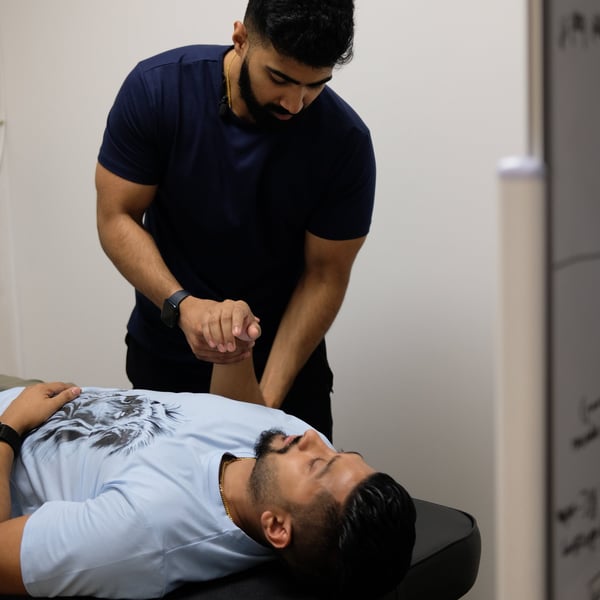
An MRI shows what your tissues look like at rest. A good evaluation shows how your body works, what provokes your pain, and what calms it down.
1
It screens for red flags first.
The first job is ruling out anything serious. Research shows fewer than 1% of acute back pain cases in primary care involve serious pathology, but those few need to be caught early.
2
It finds what provokes and eases your symptoms.
Which movements, positions, and loads bring your pain on, and which ones settle it? That pattern points to what's driving your pain in a way a still image can't.
3
It tests how you move and what you can handle.
Strength, control, and capacity under load tell you where the body is overworking to compensate. That's what a plan is built around.
4
It uses validated clinical tests.
For knees, research shows a careful exam can be as accurate as MRI for meniscus tears, and in ER visits for acute knee injuries, 93.5% turned out to be soft tissue injuries rather than fractures. For shoulders, specific test clusters can identify rotator cuff problems with 99% specificity.
5
It coordinates imaging when it's needed.
If the evaluation shows something that needs imaging or a physician, we say so and coordinate it. The goal is the right care, not avoiding imaging at all costs.
Whether it's low back pain physical therapy or knee pain physical therapy, every plan here starts with that kind of evaluation. You can read what other patients have said about starting without a scan.
| X-ray | MRI | Ultrasound | |
|---|---|---|---|
| What it shows | Bones, alignment, joint space, fractures | Soft tissue detail: discs, nerves, tendons, labrum, meniscus, bone marrow | Superficial tendons, ligaments, and bursae, including while they move |
| When it's used | Trauma, suspected fracture, arthritis | Red flags, progressive weakness, or no improvement after 4 to 6 weeks of care when surgery or injections are on the table | Tendons like the Achilles, rotator cuff, or gluteal tendons, and ligament checks |
| What it misses | Soft tissue like tendons, ligaments, and discs. In back pain without trauma, unexpected findings turned up in only 1 in 2,500 X-rays | Pain itself. Many findings also show up in people with no pain | Deep structures inside the joint |
When to see a doctor first
Get evaluated by a physician right away if you have:
- Numbness in the groin, inner thighs, or buttocks
- Trouble urinating, or loss of bladder or bowel control
- Leg or arm weakness that's getting worse, like a foot that drags
- Numbness spreading through your legs or arms
- A history of cancer, unexplained weight loss, or constant pain at night that doesn't change with position
- Fever, chills, night sweats, a recent infection, or a history of IV drug use
- A major fall or accident, pinpoint bone tenderness, or trouble taking four steps
- Swelling, warmth, or tenderness in one calf
- Left shoulder pain with chest pressure or shortness of breath. Treat this as an emergency.
Common questions
What if my MRI is clean but I still hurt?
If the MRI is clean, the pain is still real. Pain is a protective output of your nervous system, shaped by sensitivity, inflammation, and threat, none of which show up on a standard MRI. A clean scan just means the answer lies in how your body is working, which is exactly what a good evaluation looks at.
What happens if PT finds something that needs imaging?
We tell you directly and coordinate with your physician. Screening for red flags and knowing when something needs a doctor is part of every evaluation.
What can a physical therapist figure out without imaging?
A lot. What provokes and eases your symptoms, how you move, where you lack strength or control, and whether anything points to a red flag. For many conditions, a careful exam is as useful as imaging for guiding the plan.
What's the difference between an X-ray and an MRI?
X-rays show bones, alignment, and fractures. MRIs show soft tissues like discs, tendons, cartilage, and nerves in detail. Neither one shows pain, and both can show changes that are common in people who feel fine.
Have more questions about how we work? Check our FAQ page.
Keep reading
Revenant Physical Therapy
Waiting on a scan, or holding a scary report?
Book a free 15 minute discovery call. Tell me what's going on and what you've been told, and we'll figure out whether Revenant is the right first step. Revenant Physical Therapy is based in Farmers Branch and works with active adults from Addison, Carrollton, and across North Dallas.

Written by
Dr. Nevin Saju, PT, DPT
Founder of Revenant Physical Therapy in Farmers Branch. Three open-heart surgeries taught him what it takes to trust your body again. Now he helps runners, lifters and active adults do the same. More about Nevin →

.png?width=170&name=Revenant+long+logo+(white).png)
Comments